No products in the cart.


Peach Slab Pie
Last updated on July 21st, 2026
Table of contents
This Peach Slab Pie is loaded with fresh-picked peaches that are tossed in bourbon, brown sugar, and warm spices, nestled under a flaky, homemade lattice pie crust. As the end of the season approaches, nothing tastes better than this classic summer dessert that uses fresh juicy peaches picked from the orchard. What better way to savor this peach pie for a crowd than taking it to your end of summer picnic or Labor Day party.
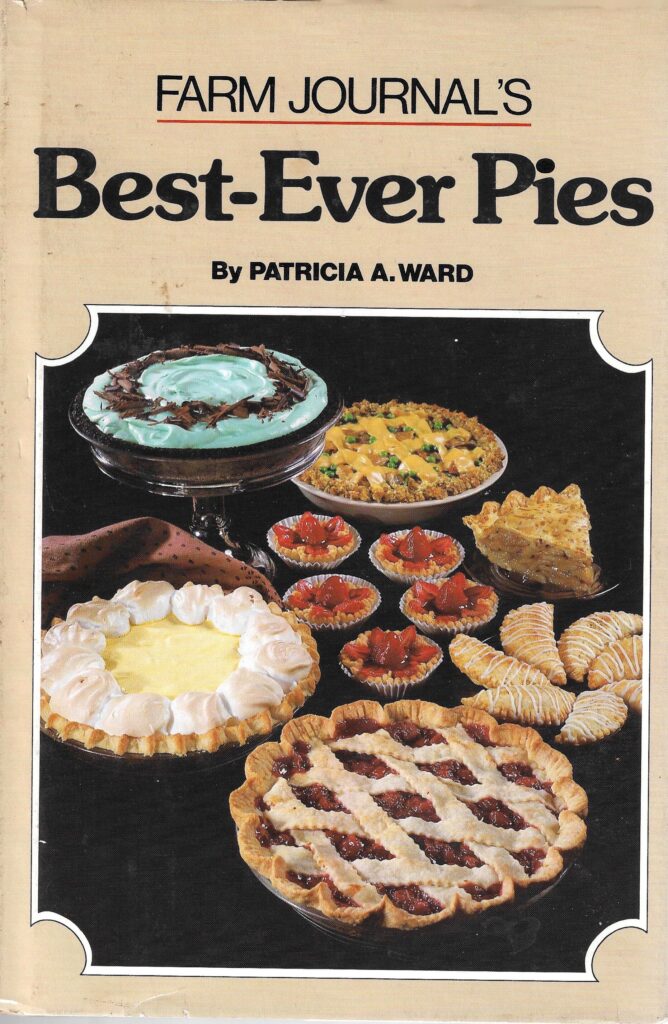
Farm Journal’s Best-Ever Pies (1981), was published by Farm Journal, an agricultural magazine. This book includes recipes for fruit pies, cream pies, custard pies, and some savory pies too. This cookbook is praised for reliable pie crust and pie filling recipes that home bakers could count on for simple recipes.
Here is an original recipe for Georgia Peach Pie, a perfect summer dessert to use up fresh-picked peaches from the orchard.

Try another recipe from this book Apple Cranberry Pie
Ingredients to make Peach Slab Pie
Pie Crust
- Unbleached flour is made from ground wheat kernels with the bran and germ removed. It has a moderate protein content of 10-12%, making it a versatile option for most baked goods.
- Sugar is a made by processing the juice of the sugarcane plant. Cane sugar is a natural option that is less processed with a slightly courser texture.
- Butter is made from churned cream that contains 80% butterfat. European butter is churned longer and has a higher fat content (82%-85%), which is why it yields more flavor.
- Pink salt is a type of rock salt found near the Himalayas, that is minimally processed and contains trace minerals.
- Vodka is a distilled alcoholic beverage made from grains or potatoes. Adding vodka to pie crust will give it a flaky, tender texture because the alcohol prevents the gluten from developing.
Pie Filling
- Peaches are a juicy stone fruit that grow on trees and ripen in late summer. They contain a large pit in the center and come in several varieties, like white and yellow, with either a fuzzy or smooth outer skin.
- Brown sugar is granulated sugar combined with molasses, sold as either light brown sugar (with 3.5% molasses) or dark brown sugar (with 6.5% molasses) for a more robust flavor.
- Instant ClearJel is a modified food starch used as a thickener, stabilizer, and gelling agent, used for pie fillings creating a clear, smooth texture rather than cloudy. In baked goods it helps retain moisture and produces a light, tender texture.
- Bourbon is a type of American whiskey made from at least 50% distilled corn and aged in oak barrels.
- Cinnamon comes from dried bark from the tropical Asian cinnamon tree and is available as whole cinnamon sticks or ground. There are two types: Cassia which has a warm, sweet flavor, and Ceylon known as “true cinnamon”, which has an intense spicy bite.
- Nutmeg is a warm spice that comes from the nutmeg tree in the Spice Islands. It is available as whole nutmeg, grated or pre-ground.
Baker’s Tips
Crust
- To avoid a tough crust, add vodka or white vinegar to prevent excess gluten from forming. This not only keeps the crust flaky, it also prevents shrinking during baking.
- To save time, make the pie crust ahead of time and place in refrigerator or freezer until needed.
- Work quick to keep everything cold as possible.
- Dice the butter into small cubes and put into the freezer prior to making the pie dough. Chill water with some ice cubes before using. After you roll out the crust, put in fridge for 15 minutes so it’s cold going into a hot oven. This step will help keep the crust from shrinking.
Pie Filling
- When using frozen fruit, do not thaw before adding it to the pie filling or it can make the pie watery and mushy.
- Fresh fruit filling or pre-made filling will both work. Its easy to pre-make homemade pie filling after you pick or harvest fresh fruit in season. Follow the USDA canning procedures or store in freezer safe containers or ziploc bags.
Assemble & Bake Pie
- To prevent a soggy crust, dust the bottom crust with a thickening agent and brush with an egg wash.
- After you dust the raw pie crust dough, prick the bottom and sides with a fork. This will help steam escape and keep the bottom of the pie flat. Another way to keep the bottom flat is to cover the crust with parchment paper and place ceramic pie weights or raw, whole beans over the parchment paper.
- Use a ceramic or glass pie plate, which conduct slow, even heat.
- To make the lattice pattern, cut strips of dough, weave into pattern on top of a piece of parchment paper. Chill until use, and lay the pattern on the top of the filling.
- For a shiny, brown crust, brush the entire pie with egg wash sprinkled with course sanding sugar.
- Put the assembled pie in the fridge for about 15 minutes prior to baking to ensure the crust from shrinking.
- Cover crust with pie protector or foil to make sure the filling is cooked through but that the crust doesn’t burn.
Dietary Substitutions
For the past 12+ years, I have owned an all-natural specialty bakery converting conventional recipes to gluten free, vegan, wholesome, etc. You can read more about my pro-baking here.
Here are a few basic tips when converting conventional recipes into specialty baked goods.
- Shelf Life: Specialty baked goods tend to dry out faster and have a shorter shelf life than conventional baked goods. Store in an airtight container on counter for 1 – 2 days. For longer storage, freeze up to 6 months. Avoid refrigerating, as it can dry out baked goods.
- Let Batter Rest: Alternate flours can be dense or slightly gritty compared to white flour, so be sure to let the batter rest at least 15 minutes or overnight in the refrigerator before baking. This allows the flour to fully hydrate and produce a lighter, tender crumb.
- Oven Temperature: Alternative flours are delicate and tend to brown faster before the center is cooked through. Reduce oven to 325° and bake “low and slow,” adding a few extra minutes of bake time if needed.
Gluten-Free (no gluten)
- Flour: Swap out the flour with a premium gluten-free flour such as King Arthur Measure for Measure or use a homemade gluten-free flour blend. Be sure the flour blend contains xanthan gum or add 1/4 tsp. to 1/2 tsp. per every 1 cup of flour to the recipe.
- Hydration: Gluten free flours can make baked goods dense. Add 1 tablespoon of additional extra liquid (the same liquid called for in the recipe) to help lighten the texture.
- Fat: Add up to 1 to 2 Tbsp of additional fat, such as butter or oil to the recipe.
Vegan/Dairy Free (no animal products)
- Butter: Use unsalted vegan butter sticks such as Violife for best flavor and texture.
- Dairy: Replace dairy with unsweetened plant based milk such as oat, coconut or almond milk.
- Eggs: Replace each egg by adding 1 tsp. baking soda to the batter, then pour 1 Tbsp. white vinegar over it. Add the vinegar last though, to keep the leavening reaction.
- Fat: Add up to 1 to 2 Tbsp of additional fat like oil or vegan butter to the recipe.
Keto (low carb, high fat)
- Flour: Swap the white flour for almond flour or coconut flour.
- Sweetener: Replace sugar with Lakanto Monkfruit Sweetener which calls for a 1:1swap that mimics granulated sugar.
- Dairy: Replace dairy with unsweetened plant based milk such as coconut or almond milk.
- Hydration: Almond flour can make baked goods dense. Add 1 -2 tablespoons of additional extra liquid (the same liquid called for in the recipe) to help lighten the texture. Add 1 additional egg to help bind the batter.
- Fat: Add up to 2 Tbsp of additional fat, such as butter or oil to the recipe.
Wholesome (minimally processed)
- Flour: Swap out 1/3 to 1/2 of the white flour with King Arthur white whole wheat flour or King Arthur 100% whole wheat flour or Bob’s oat flour.
- Sweetener: Replace white sugar with maple syrup or honey. Use 3/4 c. honey for every 1 c. sugar. You can also swap out the white sugar with 1:1 swap using natural cane sugar, coconut sugar or date sugar.
- Dairy: Replace dairy with unsweetened plant based milk such as oat, coconut or almond milk.
- Lower Fat: For every 1 c. of butter, use 3/4 c. heart-healthy oil (like canola or extra-light olive) OR 1/2 c. unsweetened applesauce + 1/2 c. oil.
Allergen Free (none of the 9 allergens)
- Flour: Swap out the flour with a premium gluten-free flour such as King Arthur Measure for Measure or use a homemade gluten-free flour blend that does not contain tree nuts or soy. Be sure the flour blend contains xanthan gum or add 1/4 tsp. to 1/2 tsp. per every 1 cup of flour to the recipe. Here is a list of some other gluten-free flours to try.
- Butter: Use unsalted vegan butter sticks such as Violife for best flavor and texture. Add up to 1 to 2 Tbsp of additional fat like oil or vegan butter to the recipe.
- Dairy: Replace dairy with unsweetened plant based milk such as oat or coconut milk. Check the labels to make sure they are soy-free and nut-free.
- Eggs: Replace each egg by adding 1 tsp. baking soda to the batter, then pour 1 Tbsp. white vinegar over it. Add the vinegar last though, to keep the leavening reaction.
- Nuts: Omit all peanuts and tree nuts (almonds, brazil nuts, cashews, hazelnuts, macadamia nuts, pecans, pine nuts, pistachios, or walnuts.
Storage & Freezing
Baked: Cover the pie with saran wrap or foil and keep at room temperature 2 – 3 days.
Baked (long-term storage): If pie has been baked, freeze up to 6 months.
Unbaked Pie: Cover pie with saran wrap or foil and place covered pie in a freezer-safe container or vacuum-sealed bag for up to 6 months. Bake pie straight from freezer and add additional baking time as needed.
FAQ’s
Can I use frozen peaches in the pie filling?
Yes. Pull out frozen fruit first and let it come to room temperature as you begin to start baking. Lightly toss in flour or cornstarch to absorb any excess moisture before folding into the batter to distribute evenly.
What is the best type of pan to use for this peach slab pie recipe?
Light-colored aluminum bread pans are best for conducting even heat. Glass or ceramic pie plates also hold up well to the high heat that pie requires.
How can I keep the bottom of the pie from getting soggy?
To prevent a soggy crust, dust the bottom crust with a thickening agent (like clearjel or cornstarch) and then brush with an egg wash on top of it before adding the pie filling.
How to pick and preserve fresh-picked peaches
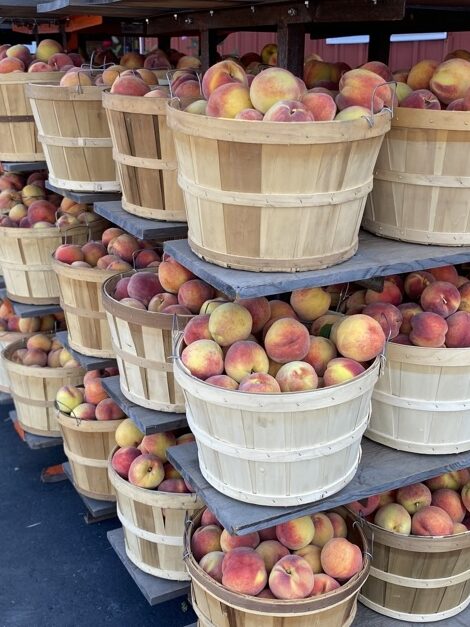
- Pick peaches early in the morning when temperature is cooler and the bugs are less active.
- Wear a long-sleeve shirt to protect your arms fro branches, a hat for shade, and lots of bug spray!
- Bring your own containers like large reusable bags, coolers or large buckets to transport the fruit home.
- Keep the fruit as cool as possible in your vehicle. Place frozen ice bricks in the coolers and turn on the air conditioning.
- Short-term: lay out peaches on parchment or newspaper on a table. Some of the peaches are ready to process while others may need a few days to ripen. Place in the refrigerator for up to 2 weeks.
- To remove skins: par-boil peaches in hot water for 20 seconds, shock in ice cold water, remove peach skins. Then remove pit, slice, and sprinkle with a light coating of sugar.
- To freeze: remove skins and center pit. Slice peaches and lay in a single layer on a 1/2 sheet pan lined with parchment paper. Freeze for 1 hour or until solid, and then put them in ziploc bags or vacuum seal them for up to 1 year.
- To can: follow the USDA guidelines.
Peach Slab Pie
Peach Slab Pie is made with fresh picked peaches tossed in bourbon, brown sugar and warm spices, nestled in a homemade lattice top pie crust.
Servings: 8
Print Recipe Pin RecipeEquipment
- pie protector
Ingredients
CRUST
- 2 c. unbleached flour
- 1 tsp. sugar
- 1 tsp. salt
- 12 T. butter cold & diced into cubes
- ⅓ c. ice cold water
- 1 T. vodka lemon juice or white vinegar
PIE FILLING
- 7-8 c. sliced peaches (12-14 peaches) cut and sliced or in chunks
- ½ c. brown sugar
- ¼ c. sugar
- ¼ c. bourbon
- 3 T. instant ClearJel OR cornstarch
- 1 tsp. cinnamon
- ¼ tsp. nutmeg
- 2 T. diced butter
- egg wash (1 egg+1 T. cream)
Instructions
PREP
- Preheat oven to 400°
- Mix together dry ingredients into a bowl.
- Peel, remove pit, and cut peaches and set aside.
- Place ice cubes in glass of water and set aside.
- Dice up butter into small cubes and put in freezer until making the crust.
PIE CRUST
- Put dry ingredients in food processor or stand mixer.Add cold butter, water, and vodka and pulse just until the dough comes together (crumbly). Remove bowl from food processor and add vinegar and water. Continue to mix by hand with pastry blender until just combined.
- Pour crust dough onto a piece of saran wrap, cut in half and shape into (2) round disks. Roll out each disk of dough using the thinest setting on the rolling pin, between 2 sheets of parchment paper. Chill for 15-20 minutes.
- Take out one of the pie disks and roll out on lightly floured surface into a rectangle. Use a pastry cutter to cut into 10 (1") strips. Place strips on a baking sheet lined with parchment paper.
- Use up leftover dough and cut out decorative shapes with pie cutters or mini cookie cutters and put back in fridge until ready to use.
- Use the second disk for the bottom crust and roll out into a rectangle with at least 1" overhang. Place inside a 1/2-sheet baking pan, crimp and trim edges.
- Dust bottom of crust with thickening agent (clear jel or tapioca) and then brush lightly with egg wash. Pierce pie shell with fork.
PIE FILLING
- In a separate bowl, toss together peaches, bourbon, brown sugar, sugar, and clearJel and stir together.
- Pour filling into bottom crust, and scatter the small pieces of diced butter over the filling. Place the pre-cut pastry strips into a lattice pattern on top of the filling. Brush lattice with remaining egg wash and sprinkle with course sanding sugar. Place assembled pie in fridge to chill for 10 minutes.
BAKE
- Bake pie at 400° for 15 minutes. Reduce oven to 375°, cover with foil or pie protector over the crust edge and bake an additional 45-50 minutes. Watch to see when pie starts to bubble, then let it bake 5 more minutes.
Notes
Dietary Substitutions
For the past 12+ years, I have owned an all-natural specialty bakery converting conventional recipes to gluten free, vegan, wholesome, etc. You can read more about my pro-baking here. Here are a few basic tips when converting conventional recipes into specialty baked goods.- Shelf Life: Specialty baked goods tend to dry out faster and have a shorter shelf life than conventional baked goods. Store in an airtight container on counter for 1 – 2 days. For longer storage, freeze up to 6 months. Avoid refrigerating, as it can dry out baked goods.
- Let Batter Rest: Alternate flours can be dense or slightly gritty compared to white flour, so be sure to let the batter rest at least 15 minutes or overnight in the refrigerator before baking. This allows the flour to fully hydrate and produce a lighter, tender crumb.
- Oven Temperature: Alternative flours are delicate and tend to brown faster before the center is cooked through. Reduce oven to 325° and bake “low and slow,” adding a few extra minutes of bake time if needed.
Gluten-Free (no gluten)
- Flour: Swap out the flour with a premium gluten-free flour such as King Arthur Measure for Measure or use a homemade gluten-free flour blend. Be sure the flour blend contains xanthan gum or add 1/4 tsp. to 1/2 tsp. per every 1 cup of flour to the recipe.
- Hydration: Gluten free flours can make baked goods dense. Add 1 tablespoon of additional extra liquid (the same liquid called for in the recipe) to help lighten the texture.
- Fat: Add up to 1 to 2 Tbsp of additional fat, such as butter or oil to the recipe.
Vegan/Dairy Free (no animal products)
- Butter: Use unsalted vegan butter sticks such as Violife for best flavor and texture.
- Dairy: Replace dairy with unsweetened plant based milk such as oat, coconut or almond milk.
- Eggs: Omit egg for the egg wash and use plant based cream or water.
- Fat: Add up to 1 to 2 Tbsp of additional fat like oil or vegan butter to the recipe.
Keto (low carb, high fat)
- Flour: Swap the white flour for almond flour or coconut flour.
- Sweetener: Replace sugar with Lakanto Monkfruit Sweetener which calls for a 1:1swap that mimics granulated sugar.
- Dairy: Replace dairy with unsweetened plant based milk such as coconut or almond milk.
- Hydration: Almond flour can make baked goods dense. Add 1 -2 tablespoons of additional extra liquid (the same liquid called for in the recipe) to help lighten the texture. Add 1 additional egg to help bind the batter.
- Fat: Add up to 2 Tbsp of additional fat, such as butter or oil to the recipe.
Wholesome (minimally processed)
- Flour: Swap out 1/3 – 1/2 of the white flour with King Arthur white whole wheat flour or King Arthur 100% whole wheat flour or Bob’s oat flour.
- Sweetener: Replace sugar with maple syrup or honey. Use 3/4 c. honey for every 1 c. sugar.
- Dairy: Replace dairy with unsweetened plant based milk such as oat, coconut or almond milk.
- Lower Fat: For every 1 c. of butter, use 3/4 c. heart-healthy oil (like canola or extra-light olive).
Related Recipes
More Pie Recipes
Vintage Cookbooks
Tried this recipe? Leave a comment below!
Follow us on social to see more of our cozy collection curated for nostalgic bakers who love looking at vintage cookbooks, original vintage recipes, and retro magazine clippings.
This post may contain affiliate links. As an Amazon Associate, I recommend products I like to use or suggest and may receive a small commission at no cost to you. Please see my full disclosure for more details.
Any commentary, notes, or recipe adaptations are my own and reflect my professional baking experience in an FDA-inspected, commercial kitchen. I am not a licensed medical professional and do not provide medical advice.
All modern recipe adaptations and photography © 2025 Vintage Baked Modern LLC. Please do not copy or reproduce without perm
