Lincoln’s Favorite Cake
Last updated on May 6th, 2026
Table of contents
What was Abraham Lincoln’s Favorite Cake?
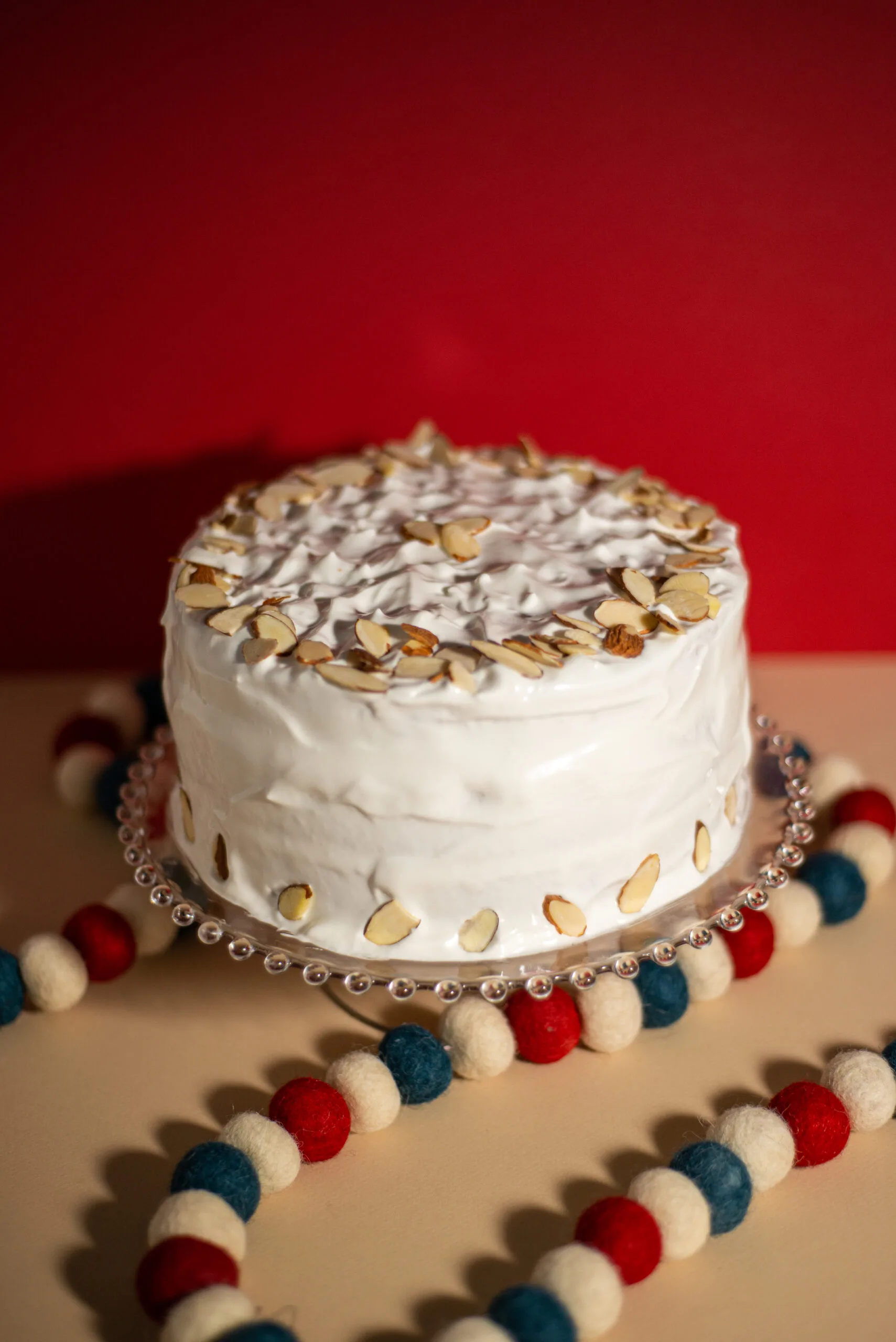
Lincoln’s Favorite Cake is a rich, white cake with egg whites and finely ground almonds, frosted with an old-fashioned creamy boiled white frosting, and topped with slivered almonds. This historical cake dates back to the mid-19th century and was commonly served in honor of Lincoln’s Birthday on February 12th.
It is sometimes called a ‘Mary Todd Lincoln Cake’ because she apparently baked a version of it for Mr. Lincoln while they were courting. To celebrate Presidents’ Day try Abraham Lincoln’s Favorite Cake or my Historic Washington Cake.
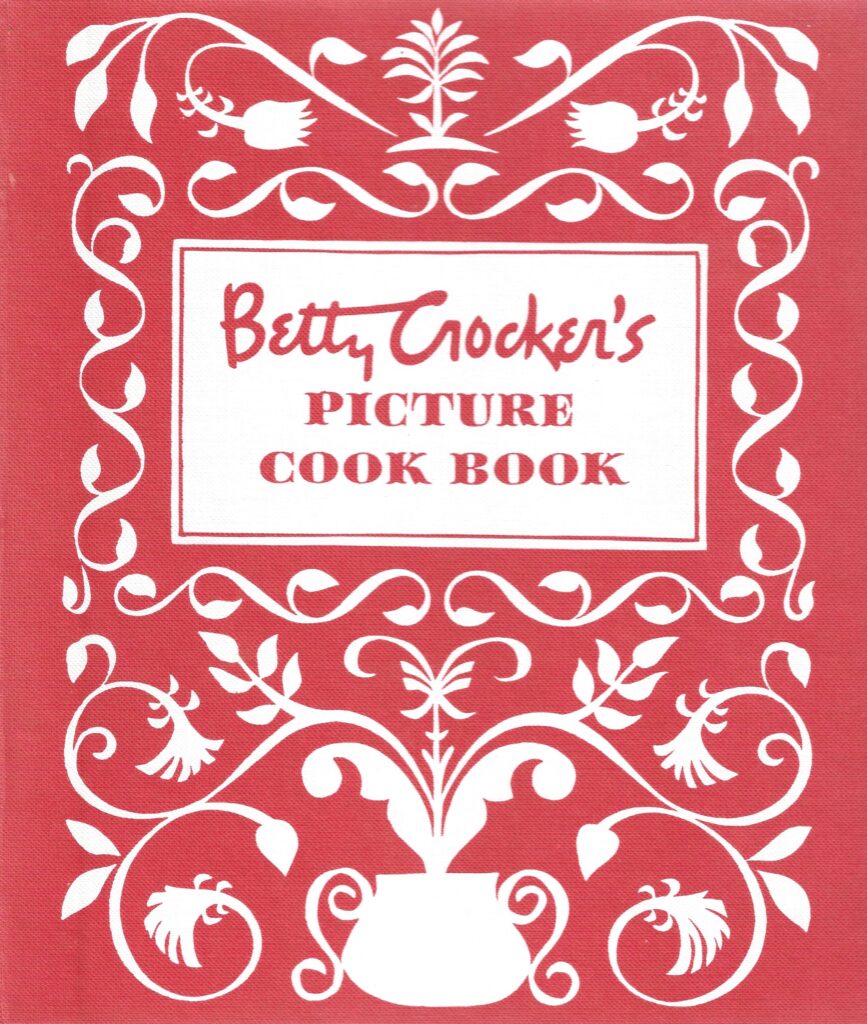
My vintage inspiration for Abe Lincoln’s Favorite Cake is from my “Betty Crocker’s Picture Cookbook” (1950, 1998). The recipe is based on the “Rich White Cake” and calls for the addition of slivered almonds and Tutti-Frutti Frosting between the layers and top. The frosting is a “Fluffy White Frosting” base with chopped nuts, candied cherries, date and raisins. However, I wanted to keep this cake closer to other historic Lincoln cake recipes and just used a simple white frosting.
Betty Crocker’s Picture Cook Book (1950, 1998 edition) is a beloved classic that has guided generations of home cooks through everything from meal planning to timeless baked goods like cakes, pies, and cookies. My copy is the 1998 edition, that preserves the charm of the original—with step-by-step color illustrations, vintage artwork, and nostalgic recipes adapted for today’s kitchens.
First published in 1950, this cookbook was revolutionary for its time. It was nicknamed “Big Red,” iand featured meal-planning tips, recipe instructions with photos, and actual tested recipes that helped define mid-century American cooking. It sold nearly a million copies in its first year and remains one of the most collected cookbooks of all time.
Try the recipe inspired by the book Coconut Macaroon Cookies
How I baked it modern: I used less all-purpose flour and added a bit of cornstarch for a light, tender texture in the cake, used of combination of baking powder and baking soda because, when combined with the acid in the buttermilk, it helps the cake rise well, added a little bit of almond extract to the cake to enhance almond flavor, substituted butter for the shortening and added a bit of canola oil to compensate for the lower fat content in butter, and used buttermilk vs. just “weak milk” in the original recipe to add tenderness
Ingredients to make a Lincoln Cake
Wet Ingredients
- Butter: American butter is made from churned cream that contains 80% butterfat. European butter is churned longer and has a higher fat content (82%-85%), which is why it yields more flavor.
- Oil: Canola oil has a neutral and light flavor and is great for baked goods. Extra Light Olive Oil is another option. If your cake recipe calls for butter, you can substitute using all oil or if you still want to get flavor from butter use a combination of oil and butter together.
- sugar: Sugar is derived from sugarcane and provides sweetness to baked goods. The most common type being granulated white sugar. Cane sugar is a natural option that is less processed with a slightly courser texture.
- eggs: Eggs are important in baking because their protein provides structure, they are a natural leavener trapping air that expands during baking, and they add moisture to baked goods.
- Buttermilk: Buttermilk adds a tangy flavor and yields tender baked goods. When purchasing buttermilk, look for simple, natural ingredients such as “cultured milk”.
- vanilla extract: Vanilla provides hints of caramel and spice, enhancing the depth of flavor to baked goods. Always use a high-quality, all-natural brand made from real vanilla beans containing at least 35% alcohol.
- Almond Extract: All-natural almond extract is made from bitter almonds or pits of stone fruits (like apricots) soaked in alcohol. Avoid using artificial almond extract, as it tastes bitter and lacks the depth of natural almond flavor.
Dry Ingredients
- Flour: Use all-purpose unbleached flour with 10-12% protein, such as King Arthur or Sir Galahad Artisan Flour (its bulk-purchased name) which has 11.7% protein. Avoid bread flour, as its higher protein content (11-14%), develops more gluten, which results in dense baked goods.
- Almond Flour: Superfine almond flour is made from blanched almonds and ground into a fine, powdery texture ideal for delicate baked goods like macarons and pastry.
- Almonds: Blanched almonds are ideal for baking because the skins have been removed, giving them a pale appearance and milder flavor compared to raw almonds with skins. For this recipe you can use ground blanched almonds, almond meal, or almond flour in the cake.
- Cornstarch is made from the starchy center of dried corn kernels and often used as a thickener in pie fillings and lightens the texture of baked goods.
- Baking soda: Baking soda (sodium bicarbonate) is a leavening agent that, when combined with an acid (such as lemon juice, buttermilk, or vinegar) creates carbon dioxide gas, making baked goods rise during baking. If your recipe doesn’t include an acid, use baking powder, or a combination of both baking powder and baking soda for balanced leavening.
- Baking powder: Baking powder is a leavening agent that contains both an acid, like cream of tarter, and a base, like baking soda to help baked goods rise. Use a double-acting aluminum-free baking powder to avoid a bitter aftertaste.
- salt: Use a fine-ground pink salt which adds essential minerals and nutrients to baked goods.
FROSTING
- Superfine Sugar: Superfine sugar, also known as castor sugar, has a finer texture compared to granulated sugar. Its fine granules help yield tender baked goods by incorporating quickly with other ingredients. When making boiled frostings or candy, superfine sugar dissolves faster, reducing grittiness and creating a smoother texture.
- Cream of Tarter is an acid used to stabilize egg whites in frostings and meringues, helping them hold their structure. Use 1 tsp. lemon juice as a substitute for 1/2 tsp. of cream of tarter.
Make Your Own Ingredients
Vanilla: Purchase Grade B vanilla beans (also called extract-grade), which have less moisture and a more concentrated flavor. Place 8 oz. of bourbon (or vodka) in glass bottle or jar. Split 5-7 vanilla beans down the middle and add to bottle. Let it sit for 3-6 months in a cool, dark place. As you use it, continue to replace the bourbon and add more beans as it keeps for many years.
Buttermilk: Place 1 T. vinegar or lemon juice into a liquid measuring cup and add cream or whole milk until it reaches the 1 c. measure line and let it sit for a few minutes.
- Grind blanched almonds to a very fine chop with a texture like crumbly flour. Almond meal will also work.
- Set out the eggs before you start baking to come to room temperature. Beat the egg whites first before mixing up the rest of the batter, since they need to be made in a clean, non-greasy bowl to help them “whip” up. Gently fold by hand into the batter to help keep the cake light.
- To lock in moisture in the cake, pull cake out of oven and immediately cover it with a baking sheet. Let it cool for about 5 minutes, run a spatula around the edges and turn the cake out onto a piece of parchment paper. Then wrap right away in saran wrap to seal in moisture.
- Keep decorating simple and natural. Use natural ingredients that complement the flavor profile of the cake.
Dietary Substitutions
For the past 12+ years, I have owned an all-natural specialty bakery converting conventional recipes to gluten free, vegan, wholesome, etc. You can read more about my pro-baking here.
Here are a few basic tips when converting conventional recipes into specialty baked goods.
- Shelf Life: Specialty baked goods tend to dry out faster and have a shorter shelf life than conventional baked goods. Store in an airtight container on counter for 1 – 2 days. For longer storage, freeze up to 6 months. Avoid refrigerating, as it can dry out baked goods.
- Let Batter Rest: Alternate flours can be dense or slightly gritty compared to white flour, so be sure to let the batter rest at least 15 minutes or overnight in the refrigerator before baking. This allows the flour to fully hydrate and produce a lighter, tender crumb.
- Oven Temperature: Alternative flours are delicate and tend to brown faster before the center is cooked through. Reduce oven to 325° and bake “low and slow,” adding a few extra minutes of bake time if needed.
- Alternative Flours: Try using alternative flours in your baking..here is a reference I put together of Ultimate Guide to Flours.
Gluten-Free (no gluten)
- Flour: Swap out the flour with a premium gluten-free flour or use a homemade gluten-free flour blend. Be sure the flour blend contains xanthan gum or add 1/4 tsp. to 1/2 tsp. per every 1 cup of flour to the recipe.
- Hydration: Gluten free flours can make baked goods dense. Add 1 tablespoon of additional extra liquid (the same liquid called for in the recipe) to help lighten the texture.
- Fat: Add up to 1 to 2 Tbsp of additional fat, such as butter or oil to the recipe.
Vegan/Dairy Free (no animal products)
- Butter: Use unsalted vegan butter sticks such as Violife for best flavor and texture.
- Dairy: Replace dairy with unsweetened plant based milk such as oat, coconut or almond milk.
- Eggs: Replace each egg by adding 1 tsp. baking soda to the batter, then pour 1 Tbsp. white vinegar over it. Add the vinegar last though, to keep the leavening reaction.
- Fat: Add up to 1 to 2 Tbsp of additional fat like oil or vegan butter to the recipe.
Keto (low carb, high fat)
- Flour: Swap the white flour for almond flour or coconut flour.
- Sweetener: Replace sugar with Lakanto Monkfruit Sweetener which calls for a 1:1swap that mimics granulated sugar.
- Dairy: Replace dairy with unsweetened plant based milk such as coconut or almond milk.
- Hydration: Almond flour can make baked goods dense. Add 1 -2 tablespoons of additional extra liquid (the same liquid called for in the recipe) to help lighten the texture. Add 1 additional egg to help bind the batter.
- Fat: Add up to 2 Tbsp of additional fat, such as butter or oil to the recipe.
Wholesome (minimally processed)
- Flour: Swap out 1/3 to 1/2 of the white flour with King Arthur white whole wheat flour or King Arthur 100% whole wheat flour or Bob’s oat flour.
- Sweetener: Replace white sugar with maple syrup or honey. Use 3/4 c. honey for every 1 c. sugar. You can also swap out the white sugar with 1:1 swap using natural cane sugar, coconut sugar or date sugar.
- Dairy: Replace dairy with unsweetened plant based milk such as oat, coconut or almond milk.
- Lower Fat: For every 1 c. of butter, use 3/4 c. heart-healthy oil (like canola or extra-light olive) OR 1/2 c. unsweetened applesauce + 1/2 c. oil.
Allergen Free (none of the 9 allergens)
- Flour: Swap out the flour with a premium gluten-free flour or a homemade gluten-free flour blend that does not contain tree nuts or soy. Be sure the flour blend contains xanthan gum or add 1/4 tsp. to 1/2 tsp. per every 1 cup of flour to the recipe.
- Butter: Use unsalted vegan butter sticks such as Violife for best flavor and texture. Add up to 1 to 2 Tbsp of additional fat like oil or vegan butter to the recipe.
- Dairy: Replace dairy with unsweetened plant based milk such as oat or coconut milk. Check the labels to make sure they are soy-free and nut-free.
- Eggs: Replace each egg by adding 1 tsp. baking soda to the batter, then pour 1 Tbsp. white vinegar over it. Add the vinegar last though, to keep the leavening reaction.
- Nuts: Omit all peanuts and tree nuts (almonds, brazil nuts, cashews, hazelnuts, macadamia nuts, pecans, pine nuts, pistachios, or walnuts.
Storage
Baked Cake: Cover in air-tight container and leave on counter up to 3 days. To freeze, cover in saran wrap and place in freezer-safe container up to 6 months. Thaw on counter in the container for 1/2 hour before opening up the container.
Unbaked Batter: Prepare batter and place in a sealed container up to 3-5 days in refrigerator.
FAQ’s
Add just a little bit of almond extract along with the vanilla extract since it can be very strong. Be sure to use all-natural almond extract for the best flavor.
Use aluminum, light baking pans, I use Fat Daddio’s 8″ round pans.
Lincoln’s Favorite Cake
Equipment
- Stand Mixer
- Bowl
- 3 8" cake pans
Ingredients
DRY INGREDIENTS
- 2 ½ c. unbleached flour
- 1 c. blanched almonds or almond meal very fine chop
- 2 T. cornstarch
- 2 ½ t. baking powder
- ½ tsp. baking soda
- ¾ t. salt
WET INGREDIENTS
- 6 egg whites (3/4 c.) stiffly beaten
- 1 c. butter room temp
- 2 T. oil canola or extra light virgin
- 2 c. sugar
- 1 ¼ c. buttermilk
- 2 ½ tsp. vanilla
- ½ tsp. almond extract
FLUFFY WHITE FROSTING
- 2 egg whites (1/4 c.)
- ½ tsp. cream of tartar
- ¾ c. sugar superfine
- ⅓ c. water
- 1 ½ tsp. vanilla
- ½ c. slivered almonds (garnish)
Instructions
PREP
- Pre-heat the oven to 350°F.
- Whisk together the dry ingredients in a bowl and set aside.
- Separate out egg whites and set aside.
- Grease and flour (3) 8" pans or (2) 9" pans. Coat cake pans with non-stick spray and then dust lightly with flour.
BATTER
- In the bowl of an electric mixer, whip up the egg whites to stiff consistency, remove from mixer and set aside.
- Cream the butter, sugar and vanilla, and almond extract until light and fluffy.
- Add the dry ingredients and mix until just combined.
- Fold in the whipped egg whites by hand and mix until just combined.
BAKE
- Pour in cake batter filling each cake pan 2/3 full. Use a scale to make sure each layer is even. Bake at 350° for about 30 minutes, or until a wooden skewer inserted in the center comes out clean.
- Set the cakes on a wire rack to cool in the pan for 10 minutes. Turn it out of the pan to cool completely before decorating.
FROSTING
- In a saucepan mix sugar and water. Boil slowly keeping lid on pan for 3 minutes. Continue to boil until the sugar is dissolved to 242° (about 3 more minutes)
- Beat egg whites and cream of tarter in stand mixer with whisk attachment until stiff.
- Pour in hot syrup in thin stream. Add vanilla and beat until desired spreading consistency (about 5 minutes).
DECORATE
- Dust cake with boiled fluffy white frosting and decorate with thin slivered almonds.
Related Recipes
More vintage cake recipes
1950’s Cookbooks
Tried this recipe? Leave a comment below!
Follow us on social to see more of our cozy collection curated for nostalgic bakers who love looking at vintage cookbooks, original vintage recipes, and retro magazine clippings.
This post may contain affiliate links. As an Amazon Associate, I recommend products I like to use or suggest and may receive a small commission at no cost to you. Please see my full disclosure for more details.
This post includes original cookbook images and text excerpts shared for educational and historical purposes. All rights belong to the original publisher.
Any commentary, notes, or recipe adaptations are my own and reflect my professional baking experience in an FDA-inspected, commercial kitchen. I am not a licensed medical professional and do not provide medical advice.
All modern recipe adaptations and photography © 2025 Vintage Baked Modern LLC. Please do not copy or reproduce without permission.
