No products in the cart.
Easter Lamb Cake
Last updated on July 21st, 2026
Table of contents
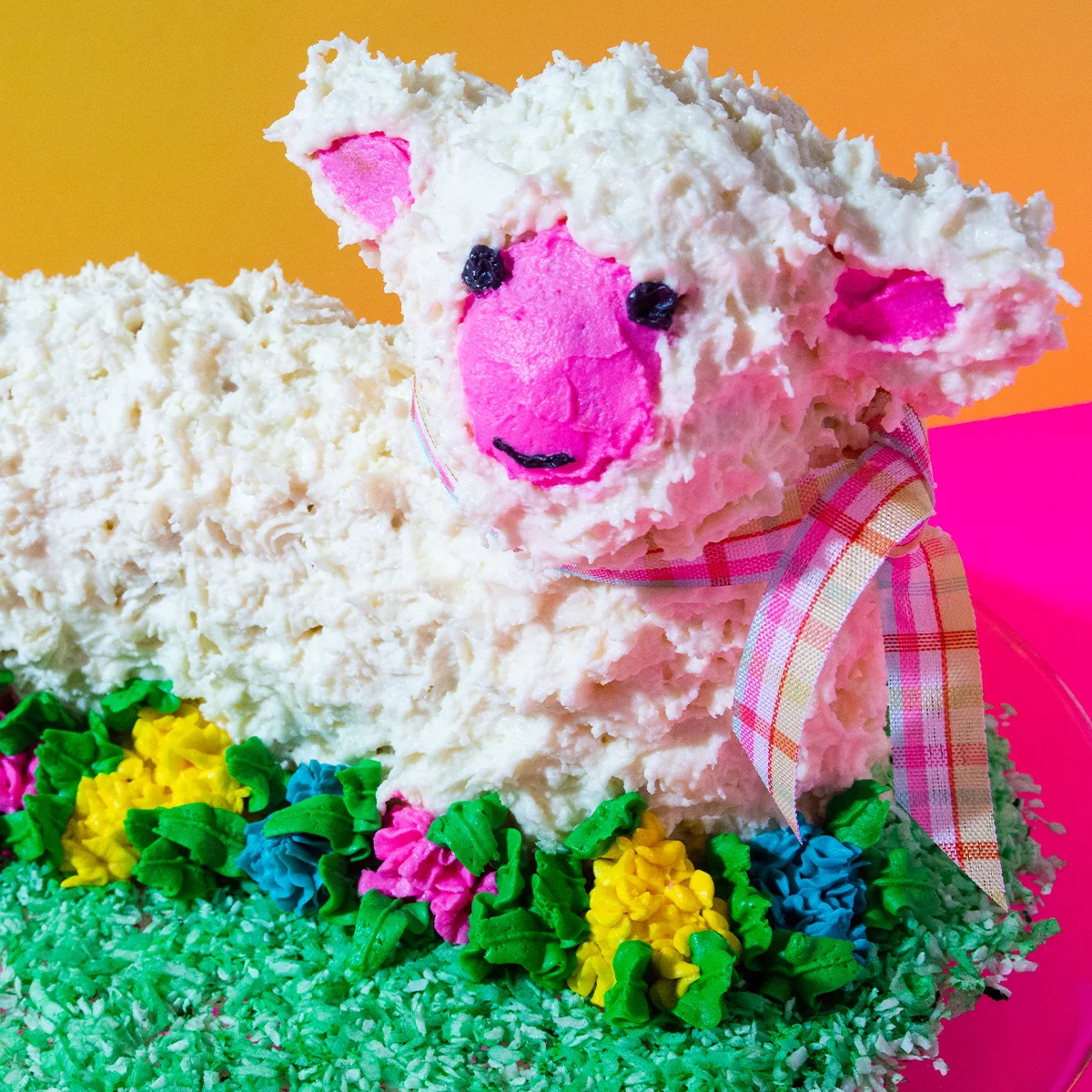
This Easter Lamb Cake is a rich pound cake baked in a vintage 3D lamb-shaped pan, covered in fluffy Swiss meringue frosting, and adorned with shredded coconut and buttercream flowers. It’s the kind of old-fashioned Easter dessert that brings a bit of nostalgia and festive centerpiece together for your holiday table.
Inspired by a vintage lamb pan and classic decorating books from the 1960s and 70s, this recipe brings a beloved baking tradition back to life. Whether you’re making it for the first time or reviving a childhood memory, this cake is easier than it looks — and absolutely worth the effort.
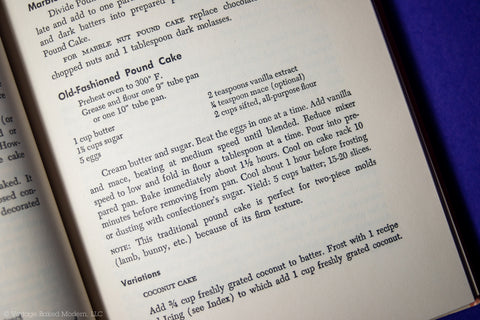
My vintage inspiration is from my copy of the 1974 “The Wilton Yearbook of Cake Decorating” book and classic recipe for pound cake in the 1969 cookbook “Decorating Cakes and Party Foods Baking Too!” by Louise Spencer.
This classic gets a Vintage Baked Modern update with a few modern ingredient tweaks and the addition of dietary substitution options (gluten-free, vegan, keto, and more) so everyone at your Easter table can enjoy a slice.


Ingredients to make Easter Lamb Cake
Dry Ingredients
- All-purpose unbleached flour is made from ground wheat kernels with the bran and germ removed. It has a moderate protein content of 10-12%, making it a versatile option for most baked goods.
- Baking powder is a leavening agent that contains both an acid, like cream of tarter, and a base, like baking soda to help baked goods rise. Use a double-acting aluminum-free baking powder to avoid a bitter aftertaste.
- Pink salt is a type of rock salt found near the Himalayas, that is minimally processsed and contains trace minerals.
- Cornstarch is made from the starchy center of dried corn kernels and often used as a thickener in pie fillings and lightens the texture of baked goods.
Wet Ingredients
- Butter is made from churned cream that contains 80% butterfat. European butter is churned longer and has a higher fat content (82%-85%), which is why it yields more flavor.
- Sugar is a made by processing the juice of the sugarcane plant. Cane sugar is a natural option that is less processed with a slightly courser texture.
- Lemons are a tart, citrus fruit that grow on trees in warm climates.
- Lemon extract is a natural flavoring made from lemon zest and alcohol. Use just a small amount to add a bright, zingy flavor to baked good recipes.
- Vanilla provides hints of caramel and spice, which enhances the depth of flavor in baked goods. Homemade vanilla is best, or use a high-quality, all-natural brand that contains at least 35% alcohol.
Frosting
- Superfine sugar, also known as baker’s sugar, has a finer texture than granulated sugar. Since it dissolves quick, it helps create a smooth texture in boiled frostings or candy.
- Cream of Tarter is an acid used to stabilize egg whites in frostings and meringues, helping them hold their structure. Use 1 tsp. lemon juice as a substitute for 1/2 tsp. of cream of tarter.
Make your own ingredients
Vanilla: Purchase Grade B vanilla beans (also called extract-grade), which have less moisture and a more concentrated flavor. Place 8 ounces of bourbon (or vodka) in glass bottle or jar. Split 5-7 vanilla beans down the middle and add to bottle. Let it sit for 3-6 months in a cool, dark place. As you use it, continue to replace the bourbon and add more beans as it keeps for many years.
Easter Lamb Cake
Step-by-Step Guide
Step #1:
When using molded cake pans, you want to use a firm, sturdy cake such as a poundcake or bundt cake recipe in order for the cake to properly stand on its own. Grease the cake mold really well with cooking spray and a light dusting of flour to ensure easy release.
Step #2:
Mix together wet ingredients and then add in the dry ingredients. Traditional poundcake does not have any leavening like baking powder or baking soda, so you must be sure to cream the butter, sugar, and eggs together whipping them long enough for it to turn light and pale creating “natural” leavening. I’ve added baking powder as well to help it rise.
Step #3:
Make a Swiss meringue buttercream. Be sure to use superfine (baker’s sugar) which dissolves faster when placed in a double broiler and when the butter is creamed.
Step #4:
Take 4 small bowls and evenly distribute the remaining white frosting in each bowl. Use a gel based color to tint at least 2 colors for the flowers, 1 green for the leaf, and 1 black for the eyes and nose. It is best to mix them using a small spatula.
Step #5:
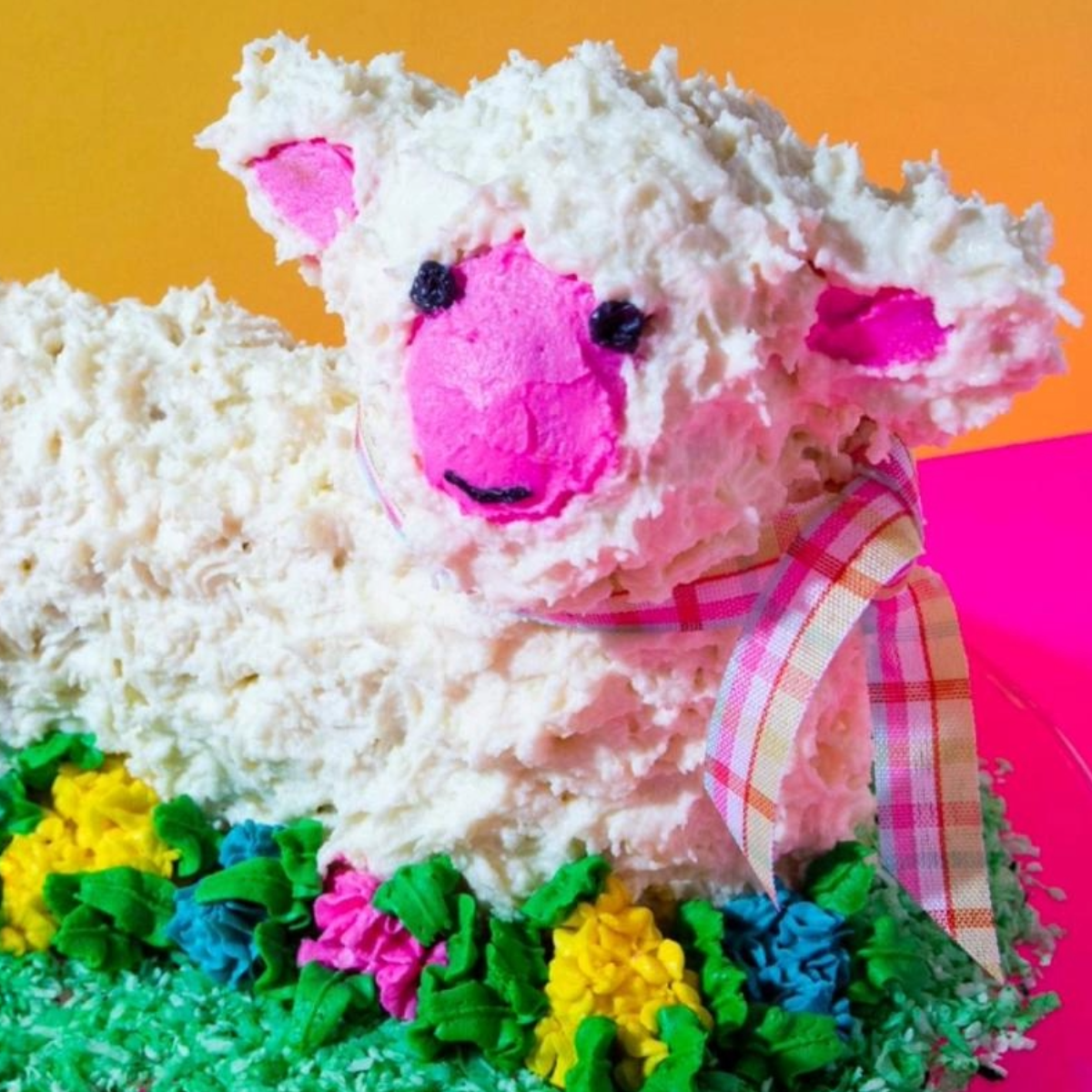
Start by piping on the pink nose and ears first before placing a light crumb-coat on the full cake. To set the crumb-coat, place cake in the fridge to chill for 10 minutes. Use a small palette knife to add the top layer “fur” by using a swirl and lift motion.
Step #6:
To finish, Pipe swirl drop flowers (yellow, pink, blue) in tip #224 and leaves (green) using a leaf tip #67 around the base of the lamb. Add green grass, pipe on a few flowers and leaves, and finish by adding a pretty ribbon around the neck.
How to convert this recipe for special diets
For the past 13 years, I’ve owned an all-natural specialty food company, specializing in converting conventional recipes to gluten free, vegan, wholesome, etc. You can read more about my professional baking background here.
Here are a few key tips when converting conventional recipes into specialty baked goods.
- Shelf Life: Specialty baked goods tend to dry out faster and have a shorter shelf life than conventional baked goods. Store in an airtight container at room temperature for 1 – 2 days. For longer storage, freeze up to 6 months. Avoid refrigerating, as it can dry out baked goods.
- Let Batter Rest: Alternative flours can be dense or slightly gritty compared to white flour, so be sure to let the batter rest at least 15 minutes or overnight in the refrigerator before baking. This allows the flour to fully hydrate and produce a lighter, tender crumb.
- Oven Temperature: Alternative flours are delicate and tend to brown faster before the center is cooked through. Reduce oven to 325° and bake “low and slow,” adding a few extra minutes of bake time if needed.
Gluten-Free (no gluten)
- Flour: Swap out the flour with a premium gluten-free flour such as King Arthur Measure for Measure or use a homemade gluten-free flour blend. Be sure the flour blend contains xanthan gum or add 1/4 tsp. to 1/2 tsp. per every 1 cup of flour to the recipe. Here is a list of some other gluten-free flours to try.
- Hydration: Gluten free flours can make baked goods dense. Add 1 tablespoon of additional extra liquid (the same liquid called for in the recipe) to help lighten the texture.
- Fat: Add up to 1 to 2 Tbsp of additional fat, such as butter or oil to the recipe.
Vegan/Dairy Free (no animal products)
- Butter: Use unsalted vegan butter sticks such as Violife for best flavor and texture.
- Dairy: Replace dairy with unsweetened plant based milk such as oat, coconut or almond milk.
- Eggs: Replace each egg by adding 1 tsp. baking soda to the batter, then pour 1 Tbsp. white vinegar over it. Add the vinegar last though, to keep the leavening reaction.
- Fat: Add up to 1 to 2 Tbsp of additional fat like oil or vegan butter to the recipe.
Keto (low carb, high fat)
- Flour: Swap the white flour for almond flour or coconut flour.
- Sweetener: Replace sugar with Lakanto Monkfruit Sweetener which calls for a 1:1swap that mimics granulated sugar.
- Dairy: Replace dairy with a high-fat milk such as whole milk or heavy cream.
- Hydration: Almond flour can make baked goods dense. Add 1 -2 tablespoons of additional extra liquid (the same liquid called for in the recipe) to help lighten the texture. Add 1 additional egg to help bind the batter.
- Fat: Add up to 2 Tbsp of additional fat, such as butter or oil to the recipe.
Wholesome (minimally processed)
- Flour: Swap out 1/3 to 1/2 of the white flour with King Arthur white whole wheat flour or King Arthur 100% whole wheat flour or Bob’s oat flour.
- Sweetener: Replace white sugar with maple syrup or honey. Use 3/4 c. honey for every 1 c. sugar. You can also swap out the white sugar with 1:1 swap using natural cane sugar, coconut sugar or date sugar.
- Dairy: Replace dairy with unsweetened plant based milk such as oat, coconut or almond milk.
- Lower Fat: For every 1 c. of butter, use 3/4 c. heart-healthy oil (like extra-light olive) OR 1/2 c. unsweetened applesauce + 1/2 c. oil.
Storage
If Baked: Cover in air-tight container and leave on counter up to 3 days. To freeze, cover in plastic wrap and place in freezer-safe container up to 6 months. Thaw on counter in the container for 30 minutes before opening up the container.
Unbaked Batter: Prepare batter and place in a sealed container up to 5 days in refrigerator. This will hydrate the flour, incorporate flavor and help the batter rise when baking.
FAQ’s
Can I make this cake ahead of time?
Yes! Prepare the batter up to 5 days ahead and store in a sealed container in the refrigerator. Or bake the cake, leave it undecorated, wrap tightly in plastic wrap and freeze for up to 6 months. When ready, thaw at room temperature for 30 minutes and decorate as directed.
What if I don’t have a lamb-shaped pan?
Well part of the nostalgia in this vintage-style cake is using the retro pan, however, you can always just use a standard lamb shaped baking pan or use a 9×13 cake and cut-out the shape of a lamb.
Can I use store-bought frosting instead of Swiss meringue?
Yes, especially if you are short on time. You just need to coat the lamb before adding the coconut “fur”. You can simply divide up and add food color to the pre-made frosting and decorate using the same method.

Easter Lamb Cake
This is a classic Lamb Cake made with traditional pound cake topped with a swiss buttercream frosting and decorated to replicate a vintage Wilton design.
Servings: 12
Print Recipe Pin RecipeEquipment
- cake pan
- piping bags
Ingredients
WET INGREDIENTS
- 1 c. unsalted butter
- 1 ½ c. sugar
- 1 Tbsp. lemon zest
- 5 eggs + 1 egg yolk
- 2 tsp. vanilla
- ½ tsp. lemon extract
DRY INGREDIENTS
- 1 ¾ c. unbleached flour
- 1 Tbsp. cornstarch
- 1 tsp. baking powder
- ¾ tsp. salt
SWISS MERINGUE FROSTING
- 4 egg whites
- 1 c. sugar superfine
- ½ tsp. cream of tarter
- 1 Tbsp. vanilla
- 1 ¾ c. butter room temp
Instructions
PREP
- Zest lemon and set aside.
- Whisk together dry ingredients and set aside.
- Preheat oven to 350°. Grease and lightly flour lamb cake pans.
MAKE CAKE BATTER
- Cream together butter, sugar, and lemon zest.
- Add in eggs and egg yolks, lemon extract and vanilla and mix for 3 minutes until light and fluffy.
- Add in the dry ingredients and mix until just combined.
BAKE
- Pour batter into the face-side down half of the pan. Place other half on top and bake for 55-60 minutes. Place toothpick in center comes out clean. Allow to cool before icing.
SWISS MERINGUE BUTTERCREAM
- In the bowl of the stand mixer, place egg whites, sugar, and cream of tarter over a pan of simmering water and stir until sugar is dissolved (about 5 minutes).
- Move bowl to stand mixer and beat for 3-5 minutes until light and fluffy. To cool down mixing bowl, place a small ice pack under the bowl.
- Once bowl has cooled down, add in butter and vanilla and mix for 3-5 more minutes until mixture turns into a buttercream consistency.
DECORATE CAKE
- In a ziploc bag, toss shredded coconut with a few drops of green gel food color.
- Take a small amount of frosting and place into small, separate bowls. Mix desired colors for eyes (black), ears/nose (pink), flowers (yellow, pink, blue) and leaves (green).
- Spread a small bit of pink frosting on ears/nose first. Then spread on a thin white crumb coat all over the cake. Chill for 10 minutes.
- Place white “fur” using a small palette knife in a swirl and lift motion.
- Pipe on eyes and a tiny line for a small mouth.
- Place green coconut flakes around the cake plate. Pipe swirl drop flowers (yellow, pink, blue) in tip #224 and leaves (green) using a leaf tip #67 around the base of the lamb. Tie a ribbon around neck of lamb.
Related Recipes
More Spring recipes
Nothing Found
It looks like nothing was found.
Tried this recipe? Leave a comment below!
Follow us on social to see more of our cozy collection curated for nostalgic bakers who love looking at vintage cookbooks, original vintage recipes, and retro magazine clippings.
📌Pinterest 👍Facebook 📷Instagram 🎵 TikTok ▶️ YouTube
As an Amazon Associate, I may include affiliate links to recommend products I like to use or suggest and may receive a small commission at no cost to you. Please see my full disclosure for more details.
This post includes original cookbook images and text excerpts shared for educational and historical purposes. All rights belong to the original publisher. Any commentary, notes, or recipe adaptations are my own and reflect my professional baking experience in a commercial kitchen. I am not a licensed medical professional and do not provide medical advice.
All modern recipe adaptations and photography © 2026 Vintage Baked Modern LLC. Please do not copy or reproduce without permission.
Comments
- Deborah Cartersays: April 3, 2021 Thank you for this recipe. I use to teach Culinary Arts and we had this cake pan in the kitchen. Do you happen to have an old recipe for lemon sugar cookies from a Betty Crocker Junior cookbook.
